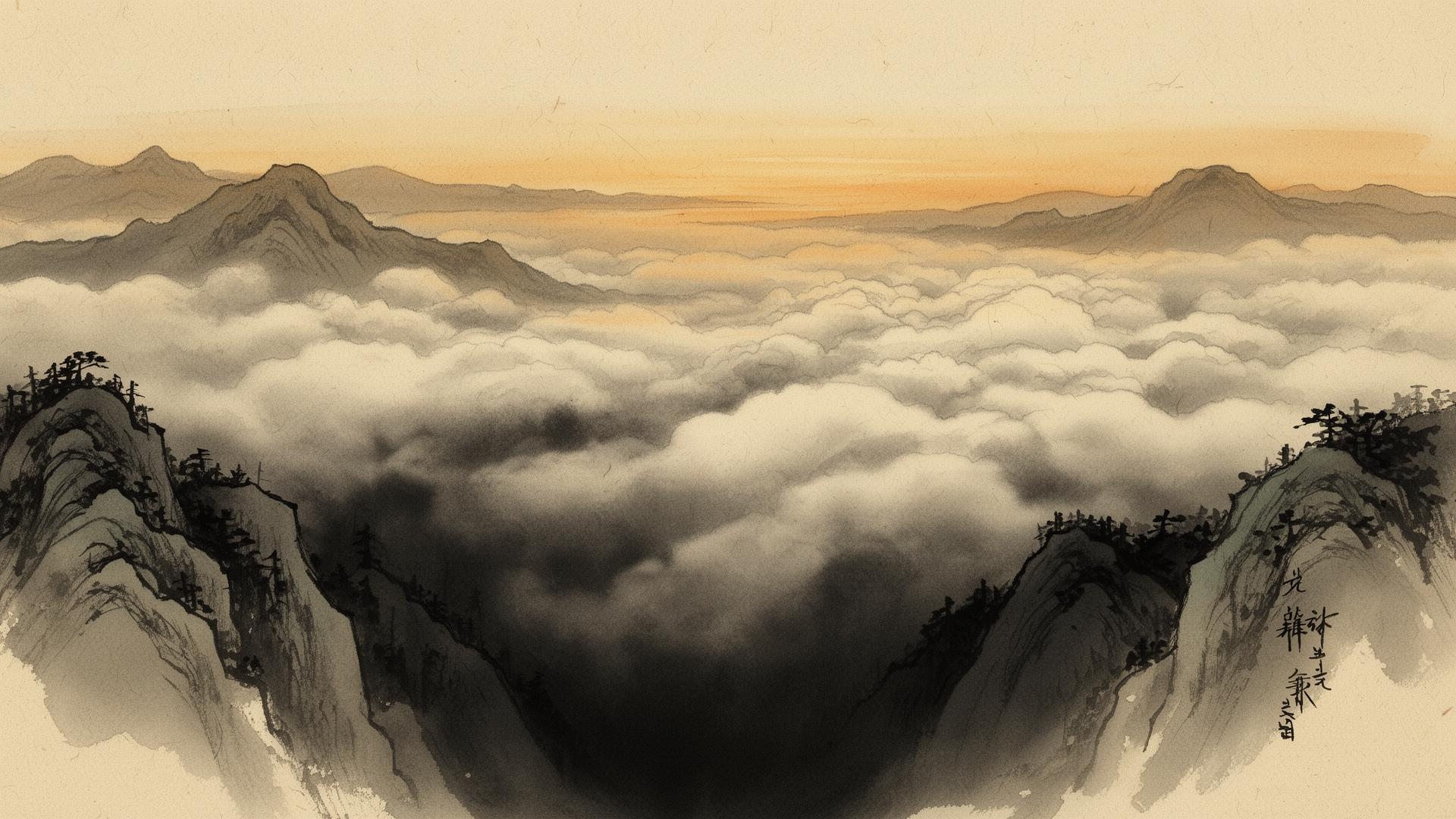
Chapter 5
The Descent of Qi 氣
Notice the dark — do not move in.
Generations and Grumbling
Each generation tends to insist that the world was finer in its youth. Perhaps the world hasn't degraded so much as the complainer's perception has narrowed. The more one grumbles, the more evidence appears.
Complaint as Mechanism
Complaint is not a neutral description. It is a posture of the qi (Chi) 氣. The Neiye 內業 observes that grief and resentment cramp the chest and dim the eyes.
Know the constant, and the mind opens; not to know the constant is to act blindly and invite calamity.
Three Simultaneous Effects of Discontent
Discontent does three things at once: it produces excess (Chapter 4), it feeds the reactive mind (dongxin 動心, Chapter 2), and it tunes one's qi (Chi) 氣 to coarser frequencies.
Personal Worlds
Two people share a street and inhabit different streets. One sees opportunity, the other danger. The physical scene is similar; the experienced scene differs. The Zhuangzi 莊子 (the classic of Master Zhuang, circa 4th–3rd century BCE — playful parables and thought experiments on perspective and freedom from fixed views) makes the point continually: perspective is constitutive.
The Whirlpool
A coarse pattern rarely seizes one at once. It works as a whirlpool: a hook of attention, an emotional reply, a deepening fascination, more related stimulus, and finally one is inside the event.
Sorrow, joy, anger, and greed — when these dwell in the heart, the Way has no place to abide.
Do Not Drink Disturbance
Disasters, scandals, sensational news — these are not unreal, but obsessive engagement with them draws one deeper into their field. The alchemist takes news the way the body takes salt: sparingly.
Media as Pattern
Alarm headline, emotional escalation, repeat, repeat. The more one returns, the more qi (Chi) 氣 is paid in. The pattern strengthens.
Fear as Doorway
Fear is the swiftest descent. Fear of illness, of loss, of failure — each fixes attention on the feared outcome and tunes the body toward it. The Daodejing 道德經 §72: 'When the people do not fear what they should fear, what they truly should fear comes upon them.'
The perfected person uses the mind like a mirror — going after nothing, welcoming nothing, responding but not storing.
On Anticipated Loss
Hearing of impending layoffs, one moves from concern to speculation to anxiety; confidence shrinks; performance suffers; the feared outcome is partly invited. The antidote is concrete action that releases the emotional charge — listing alternatives, opening doors, restoring agency.
On Illness
Illness obsessively rehearsed becomes the centre of identity. Care for the body; take counsel; do not let the diagnosis become the dwelling. The Neiye 內業 treats joy of moderation as medicine.
Interrupting the Descent
Notice early
The earlier the recognition, the lighter the work to step out.
Move the body
Walking, breathing, washing the face — physical acts redistribute qi (Chi) 氣 when the mind cannot.
Change the inputs
Stop drinking the disturbance for a while. The pattern starves.
Return to a small good
One small concrete act — sweep, water plants, send a kind message. The qi (Chi) 氣 reorients.
Core Lesson
Notice the darkness without taking residence in it.
Practice for this lesson
A heavy mood is a whirlpool: a hook of attention, an emotional reply, a deepening fascination, and soon you are inside the event. This practice interrupts the descent at the level of attention — you meet the dark clearly, name what it is feeding on, and refuse to move in and live there.
“Attain utmost emptiness; hold to stillness firmly. The ten thousand things rise together; I watch them return. Grief and resentment cramp the chest and dim the eyes — the alchemist takes such news the way the body takes salt: sparingly.”
- 1Sit. Drop the weight into the lower belly. Take one long, full breath and let the exhale be longer than the inhale.
- 2Notice the weather present today — heaviness, dread, irritation, low-grade anxiety. Name it plainly in one phrase: 'fear of the layoff', 'after the news', 'the old sadness'.
- 3Trace the hook. What did this mood begin to feed on? A headline, a conversation, a rehearsed worst case, a scroll. Notice without scolding yourself.
- 4Feel where the qi has fixed — chest tightening, jaw set, shoulders forward, eyes dimmed. Breathe low and slow into exactly that place for three breaths.
- 5Say inwardly: 'This is here. I am here. We are not the same thing.' Let the mood remain in the room without arguing with it and without moving in.
- 6Close with one small concrete good — a sip of water, opening a window, a kind message, a single tidy gesture. Feel the qi reorient toward the small act.
Reflection
- What name did you give the weight that was present today?
- What was the hook — what had attention been quietly feeding on before you sat down?
- What changed when you stopped arguing with the mood and simply let it be in the room?
- What one small concrete good is yours to do next, to step out of the whirlpool?
Heavy weather passes through everyone. The descent is interrupted not by force but by clear seeing and one small act that returns you to your own ground. You do not have to drink the disturbance to know it is there.