Chapter 10
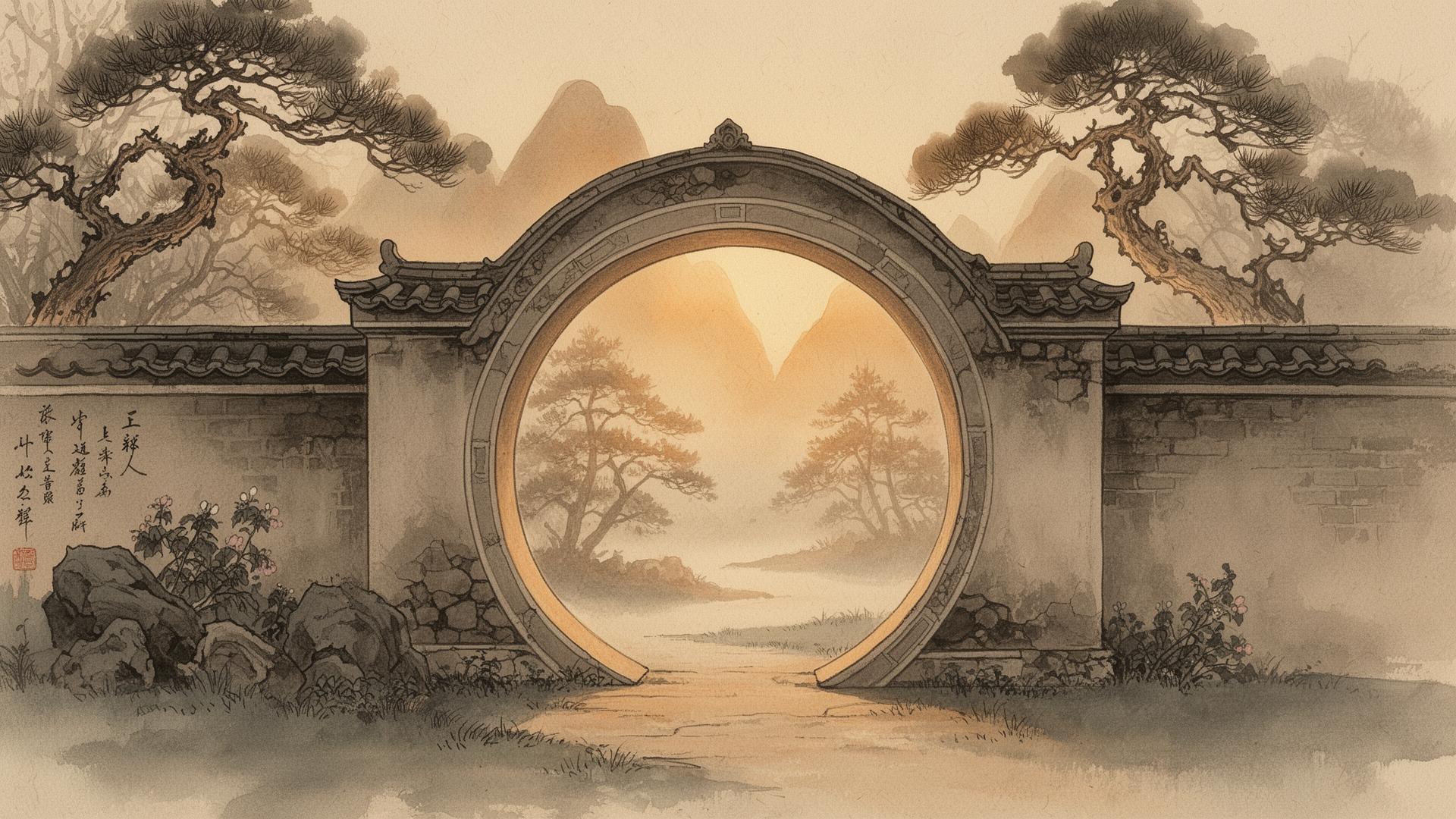
Your Own Gate
Aims that fit your nature open quietly.
Signs of Your Own Aim
Sages do not act for themselves, and so their own lives are fulfilled.
Signs of a Borrowed Aim
Finding the Gate
Often by subtraction. Remove ambitions that belong to others; what remains is closer to your own. The Daodejing 道德經 §48: 'In pursuit of learning, every day something is added; in pursuit of the Way, every day something is dropped.'
When the inner virtue is complete, the Way arrives of itself.
Walking Through
Once the gate is yours, the work is no longer to convince yourself. The work is to show up — small, regular, embodied. The gate opens to those who do not stand outside arguing.
All men know the use of the useful, but nobody knows the use of the useless.
De 德 — Inner Power
De 德 is the quiet power that arises when one lives according to one's own nature. It is not charisma; it is coherence. Others feel it without being told.
Parable: The Useless Tree
In the fourth chapter of the Zhuangzi 莊子, a master carpenter passes an enormous, ancient oak that has become a shrine. His apprentice marvels at it; the carpenter walks by without a glance. 'Useless wood,' he says — its timber would warp into boats that sink, coffins that rot, vessels that crack. That night the oak appears to him in a dream and asks: would you compare me to the fruit trees you admire? Their branches are torn off when ripe, their lives cut short by their own usefulness. I have spent a long time learning to be useless, and now in old age it preserves me. What you call useless serves me supremely well. The teaching is not idleness. It is that aims belonging to someone else's measure — what they would carve you into — exhaust the essence 精 (jing); aims that fit your own nature open quietly and keep you whole.
Core Lesson
Your gate must fit your nature. Then it opens quietly.
Practice for this lesson
Each person has their own gate — the work, the direction, the way of being that fits their nature. Striving through someone else's gate exhausts essence 精 (jing) and yields little even when achieved. This practice is a listening by subtraction: notice where effort feels light, where the body brightens unbidden, and which aims have been quietly defending themselves to an audience that is not even in the room.
“Without going out of doors, one may know the world. / In pursuit of learning, every day something is added; in pursuit of the Way, every day something is dropped.”
— Daodejing 道德經 §47 / §48
- 1Sit. Let the breath settle into the lower belly. Take three slow exhales until the room goes quiet.
- 2Ask inwardly, without hunting for an answer: where in my life does effort already feel light? Where does the work return energy rather than drain it?
- 3Wait. Do not produce a reply. Let images, places, faces, small tasks surface on their own. The mind will offer the impressive answers first; let those pass and wait for the quieter ones.
- 4Notice which of them brighten the body — a small lift in the chest, a softening behind the eyes, a yes that arrives before words. Mark them, without deciding anything.
- 5Now ask the other side: which current aim, when I name it, makes the body brace? Which one needs constant pep talks, comparison, or an audience to stay alive? Notice without scolding yourself.
- 6Hold both lists side by side for one breath. You do not have to act yet. Often the gate appears simply by removing what does not belong to you.
- 7End with one breath of thanks for what wants to be lived. Open the eyes. Carry the question, not an answer.
Reflection
- Where in your life does effort already feel light — and how long have you been overlooking it?
- Which images or people brightened the body when they surfaced unbidden?
- Which aim, honestly, would disappear if the audience did? And what remains when you set it down?
Your own gate opens quietly. You are not searching for something hidden — you are subtracting what was never yours, until what remains is recognisable. The gate opens to those who do not stand outside arguing.